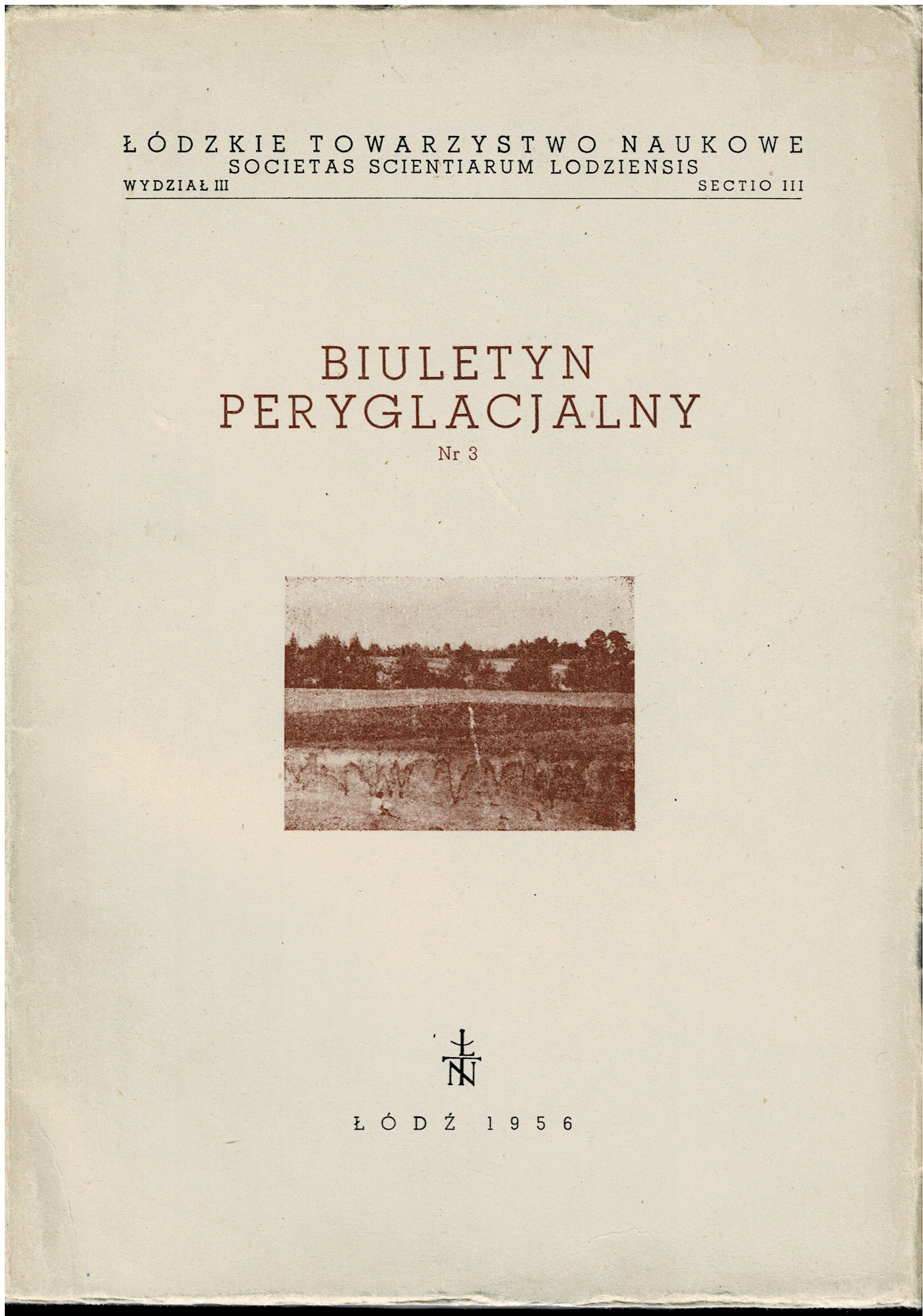
The periglacial structures at Tarzymiechy and their significance for the morphogeny and stratigraphy of the Quaternary
DOI:
https://doi.org/10.26485/BP/1956/3/2Keywords:
sedimentologic investigations, involutions, ice-wedge, zlodowacenia Riss-WürmAbstract
Sedimentologic investigations were conducted in the well-known exposure at Tarzymiechy on the Wieprz river, 25 km. above Krasnystaw. The presence of two zones of periglacial structures was established. The base zone displays bound involutions and ice-wedges, the top zone forms a well developed, massive involution layer of 3 m. Between these two zones there is a 6-7 m thic series of fluvial deposits that accumulated under dry and cold climatic conditions. Both the periglacial zones as well as the interbedded series of fluvial deposits were recognized as formations produced during one glaciation. Considering the paleobotanic and malacologic deposits of earlier interglacial origin appearing at the base of the formations im question, the entire 20 m terrace series on the Wieprz river must be correlated with the Middle-Polish glaciation (Riss). The bi-partition of the sediments records the bi-partition of this glaciation, the upper involution layer being besides related to the Warta Stage. The cut, the formation of a new valley floor and the emergence of terraces occurred toward the decline of the Middle-Polish glaciation and during the last interglacial period. During the last glaciation (Würm) the terrace surface underwent transformations that modified the new periglacial morphogeny. These transformations are recorded by denudational troughs appearing on the surface of the terrace. The corresponding, discontinuous congeliflual deposits are the geological expression of the youngest periglacial morphogeny.
References
1. Budel J., 1944 - Die morphologischen Wirkungen des Eiszeitklimas im gletscher freien Gebiet. Geol. Rundschau (Dil-geol. u. Klimaheft), Bd. 34.
2. Czarnocki J., 1927 - O zlodowaceniach środkowej części Gór świętokrzyskich (On the glaciation of the middle part of Łysogóry Mtz.). Pos. Nauk. Państw. Inst. Geol., nr 17.
3. Czarnocki J., 1931 - Dyluwium Gór świętokrzyskich (Pleistocene of Łysogóry Mts.). Roczn. Polsk. Tow. Geol., t. 7.
4. Dylik J., 1952 - The concept of the periglacial cycle in Middle Poland. Bull. Soc. Sci. Lettr. Łódź, vol. Iii, 5.
5. Dylik J., 1953 - O peryglacjalnym charakterze rzeźby środkowej Polski (resume: Du caractere periglaciaire de la Pologne centrale). Acta Geogr. Univ. Lodz., nr 4, Łódzkie Tow. Naukowe, Łódź.
6. Dylik J., 1953 - Periglacial investigations in Poland. Bull. Soc. Sci. Lettr. Łódź; vol. Iv, 2.
7. Dylik J., 1955 - Badania peryglacjalne w Polsce. Biul. Inst. Geol., 70.
8. Dylik J., Chmielewska M., Chmielewski W., 1954 - Badanie osadów jaskiniowych w Dziadowej Skale (resume: Etude des depóts de fa grotte au lieu dit „dziadowa Skała"). Biul. Perygl., nr 1.
9. Halicki B., 1948 - Charakterystyka florystyczna interglacjałów dorzecza Niemna. Wiad. Muz. Ziemi, t. 4, Warszawa.
10. Halicki B., 1955 - Znaczenie procesów peryglacjalnych dla studiów morfogenezy Karpat (Remarques sur l'importance des processus periglaciaires pour !es etu des de la morphogenese des Carpathes). Biul. Perygl., nr 2.
11. Halicki B., Sawicki L.,1934 - Less nowogródzki (Loess of Nowogródek). Zbiór prac poświęcony E. Romerowi, Lwów.
12. Horberg L., 1953 - Pleistocene deposits below the Wisconsin drift in northeastern Illinois. State Geol. Surv., Rep. of Invest., no 165.
13. Jahn A., 950 - Less, jego pochodzenie i związek z klimatem epoki lodowej (summary: Loess, its origin and connection with climate of the glacial epoch). Acta Geol. Polonica, vol. 1.
14. Jahn A., 1952 - Materiały do geologii czwartorzędu północnej części arkusza 1 : 300 O00 Zamość (summary: Materials to the Quaternary geology of the northern part of the map sheet 1 : 300 O00 Zamość). Biul. Państw. Inst. Geol., 66.
15. Klimaszewski M., 1948 - Polskie Karpaty Zachodnie w okresie dyluwialnym (Polish West Carpathian during Ice Age). Prace Wrocł. Tow. Nauk., Ser. B, nr 7.
16. Klimaszewski M., Szafer W., Szafran B., Urbański J., 1939-1950 - Flora dryasowa w Krościenku nad Dunajcem (summary: The Dryas flora of Krościenko on the river Dunajec). Biul. Paiistw. Inst. Geol, 24.
17. Klimaszewski M., Szafer W., 1945 - Plejstocen w Łękach Dolnych koło Tarnowa (summary: The Pleistocen in Łęki Dolne near Tarnów). Starunia, nr 19, Kraków.
18. Mensching H., 1950 - Schotterfluren und Talauen im Niedersachsischen Bergland. Gott. Geogr. Abhandl., H. 4.
19. Mensching H., 1951 - Akkumulation und Erosion seit der Risseiszeit in Niedersachsen. Erdkunde, Bd. 5.
20. Mensching H., 1953 - Die periglaziale Formung der Landschaft des linteren Werratales. Gott. Geogr. Abhandl., H. 14.
21. Poser H., 1950 - Die Niederterrassen des Okertales als Klimazeugen. Abhandl. Braunschw. Wiss. Ges., Bd, 2.
22. Poser H., Tricart J., 1950 - Terrasses et phenomenes periglaciaires dans la vallee de l'huisne en amant du Mans (sarthe). Bull. Soc. Geol. France, 5 ser., t. 20.
23. Pożaryski W., 1953 - Plejstocen w przełomie Wisły przez Wyżyny Południowe (summary: The Pleistocene in the Vistula Gap across the Southern Uplands). Prace Inst. Geol., t. 9.
24. Środoń A., 1954 - Flory plejstoceńskie z Tarzymiechów nad Wieprzem (summary: Pleistocene floras from Tarzymiechy on the river Wieprz). Biul. Inst. Geol., 69.
25. Szafer W., 1952 - Stratygrafia plejstocenu w Polsce na podstawie florystycznej (summary: Pleistocene stratigraphy of Poland from the floristical point of view). Roczn. Polsk. Tow. Geol., t. 22.
26. Tricart J., 1947 - Methode d'etude des terrasses. Buli. Soc. Geol. France, 5 ser., t. 17.
27. Tricart J., 1949 - La partie orientale du Bassin de Paris. t. I - La genese du bassin. Paris.
28. Tricart J., 1950 - Le modele des pays froids. fasc. I: Le modele periglaciaire. Cours de geomorphológie, 2-part, Paris.
29. Tricart J., 1951 - Formations quaternaires et evolution morphologique de la moyenne vallee de l'yonne et de la basse vallee de la Cure. Bull. Soc. Geol. France, 6 ser., t. 1.
30. Weinberger L., 1954 - Die Periglazial-Erscheinungen im osterreichischen Teil des eiszeitlichen Salzach-Vorlandgletschers. Gott. Geogr. Abhandl., H. 15.