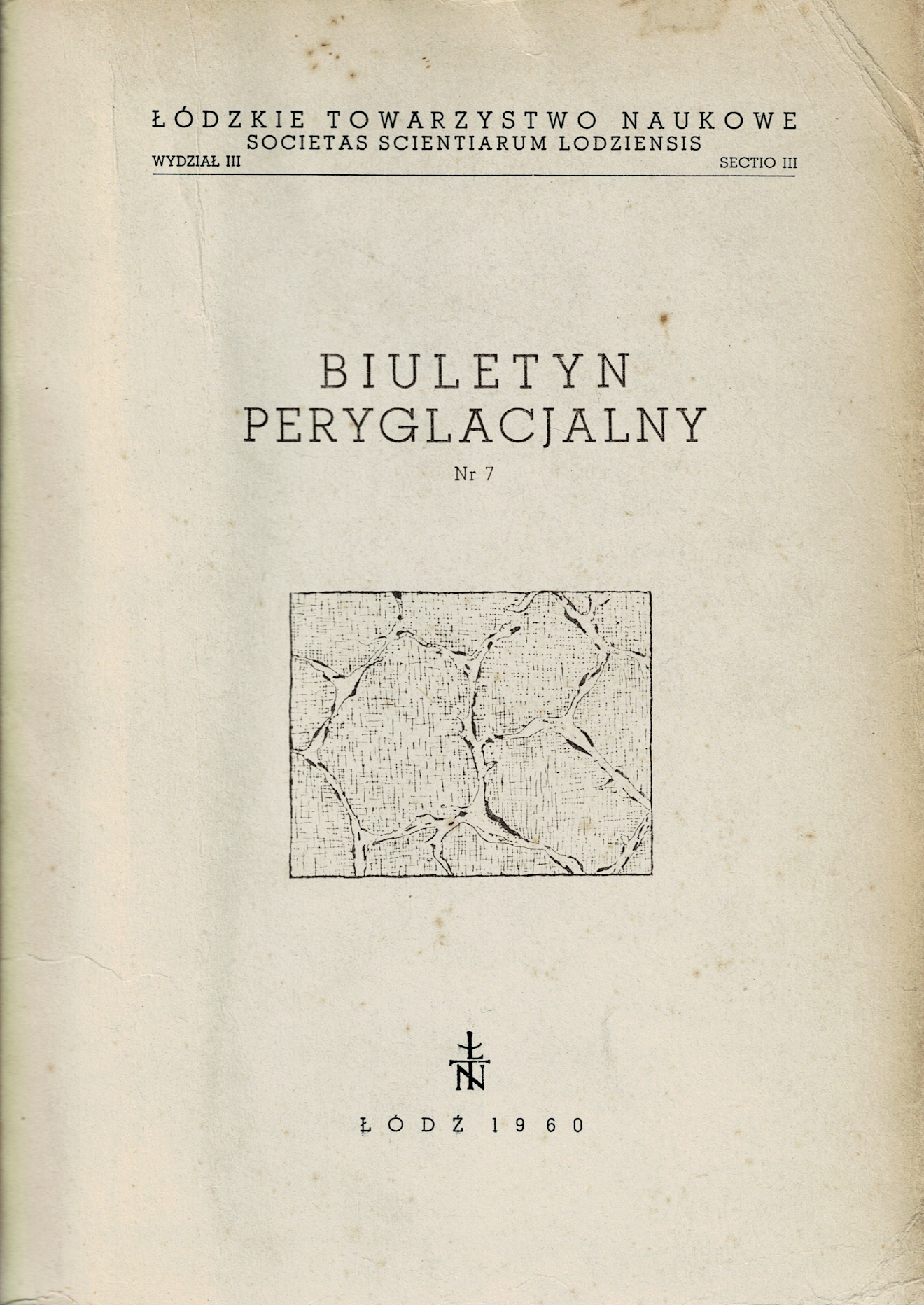
On the unusual occurrence of stone polygons in the French Alps
DOI:
https://doi.org/10.26485/BP/1960/7/7Keywords:
stone polygons, periglacial processes, sediment segregation, Lake Lauzon (Queyras)Abstract
The author describes the rare occurrence of sorted stone polygons on the floor of seasonal Lake Lauzon, located in the Queyras region of the High French Alps at an elevation of 2,294 metres above sea level. This phenomenon was previously noted by Gignoux (1931) and Chardonnet (1947–48) as being uncommon in the area. Observed in 1958, the polygons developed on the flat, periodically exposed lakebed, where wave action and intermittent flooding produced a clear separation between coarse rock fragments and a thin layer of silty clay. The polygons measure approximately 60–100 cm across, are mostly hexagonal and form a distinctive, belt-like pattern running north–south parallel to the eastern lake shore. This arrangement is interpreted as resulting from wave activity generating gentle bottom ripples and alternating zones of coarse and fine material. Conditions favourable for polygon development arise from the combination of a flat surface, an absence of vegetation cover and the coexistence of two contrasting sediment fractions. Despite occurring at an unusually low altitude for the Alps, the author considers these to be typical periglacial polygons, formed without the involvement of convective processes.
References
Chardonnet, J. 1947-8 - Le relief des Alpes du Sud. Grenoble.
Gignoux, M. 1931 - Les sols polygonaux dans les Alpes et la genese des sols polaires. Ann. Geogr., vol. 40.
Tricart, J. 1950 - Le modele de pays froids, 1: Le modele periglaciaire. Cours de geomorphologie, 2 e part, C.D.U., Paris.
Washburn, A. L. 1956 - Classification of patterned ground and review of suggested origins. Bull. Geol. Soc. America, vol. 67.